Optical Resonators
Optical resonators are fundamental building blocks of modern photonics, enabling the confinement and recirculation of light within well-defined geometries. By sustaining resonant eigenmodes, these structures enhance light–matter interaction, increase effective optical path length, and provide extreme sensitivity to refractive index, strain, and surface perturbations. Among them, whispering gallery mode (WGM) resonators exploit total internal reflection along curved dielectric interfaces, supporting high-quality (high-Q) circulating modes in microscale cavities. Their polarization-dependent response (TE/TM), spectral selectivity, and compatibility with fiber-based platforms make WGMs highly attractive for sensing, nonlinear optics, and integrated photonic systems.
By combining advanced material characterization, precise fabrication methodologies, and rigorous electromagnetic modeling, we advance high-Q optical resonator platforms toward mechanically responsive, spectrally engineered, and application-ready photonic devices. Our recent work advances the understanding and engineering of WGM-based photonic platforms across biomaterials, functionalized glass fibers, and additively manufactured micro-resonators.
Photo-Elasticity of Silk Fibroin via WGM Resonators
Our recent study investigates the strain–optic response of silk fibroin thin-film WGM cavities. Silk fibroin, a biocompatible and wearable-compatible material, exists in structurally distinct phases—amorphous (Silk I) and thermally annealed semi-crystalline (Silk II).
Both configurations exhibit typical Q-factors of ~1.6 × 10⁴. By tracking TE and TM resonance shifts under axial strain, the strain-optical coefficient K′ were quantified.
Despite only a modest (~4%) increase in Young’s modulus between phases (measured via Brillouin light spectroscopy), the photo-elastic response differs markedly. This enhancement in Silk II is attributed to the formation of β-sheet crystalline domains, which strongly influence the strain-induced refractive index modulation. These findings establish silk fibroin as a mechanically tunable photonic material and clarify the structure–property relationship governing its opto-mechanical coupling.
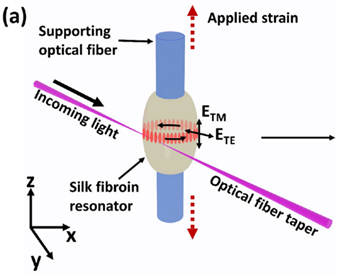
Sketch of the experimental setup for spectrally characterizing the silk fibroin resonating cavities
Mode Engineering in Thermally Poled Borosilicate Glass Hetero-Fibers
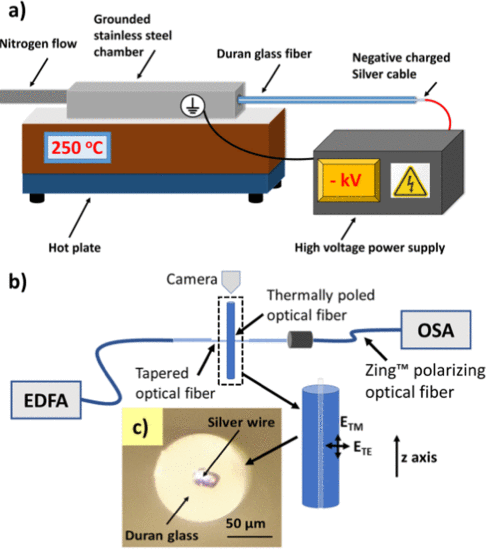
Thermal poling experimental setup
The first investigation of WGM behavior in radially thermally poled glass hetero-fibers was recently reported. Radial poling induces azimuthally symmetric ionic redistribution, resulting in refractive index modifications near the fiber circumference.
This controlled perturbation leads to a distinct spectral cleaning effect: higher-order radial modes are selectively suppressed or eliminated in both TE and TM polarizations. The structural and optical modifications are characterized through second-harmonic generation microscopy, EDX, and micro-Raman spectroscopy, and correlated directly with the measured WGM spectra.
Finite element simulations of the modal eigenstates and transmission spectra rigorously confirm the experimentally observed mode-selection mechanism. The results demonstrate a powerful route toward intrinsic modal engineering in fiber-based resonators through thermally induced symmetry-controlled index tailoring.
Micro-Ring Resonators on Fiber Tapers
Multi-photon lithography was employed as a nanoscale additive manufacturing technique to fabricate traveling-wave micro-ring resonators directly onto optical fiber tapers with a diameter of ~2.5 micrometers.
These weakly guided micro-rings, with diameters on the order of tens of micrometers, operate at 1550 nm and achieve Q-factors of ~2.0 × 10³. Beyond device demonstration, their application as compact sensing platforms, was validated, through an ethanol vapor sensor achieving detectivities down to 0.5 ppm, based on reversible physisorption-induced refractive index changes.
This approach establishes a versatile photonic prototyping framework capable of transitioning WGM-based devices from laboratory-scale demonstrations to deployable sensing and actuating systems.
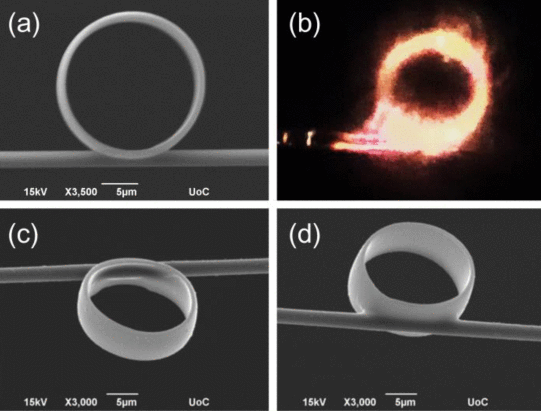
SEM images of MRRs
relevant Publications