Optical materials

Material research supports progress in photonics where controlled tailoring of mechanical, structural, and photoelastic properties directly governs light propagation, birefringence, and device functionality.

Photo-elasticity of K⁺ Ion-Exchanged Borosilicate Glass

Our recent work investigates the impact of K⁺ ion-exchange on the photoelastic response of borosilicate glass optical fibers, quantified through the Pockels’ coefficients. Using polarization-resolved whispering gallery mode resonances in cylindrical fiber cavities, strain-induced TE/TM birefringence was experimentally monitored and numerically modeled. The study reveals a ~22% reduction in p₁ᵢ coefficients after 11 h of ion exchange, followed by recovery at longer durations, linking the behavior to structural coordination changes, density variations, and K⁺ polarizability. These results establish ion-exchange as an effective route for tuning glass photoelasticity in fiber-based photonic platforms.

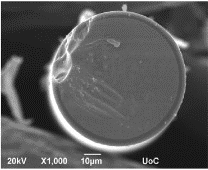
SEM picture of the cross-section of a cleaved borosilicate glass fiber

Bragg Reflector Inscription in Polypropylene No-Core Fibers

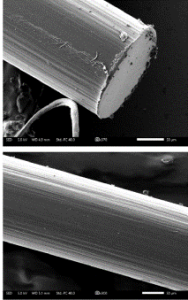
SEM images of a PP fiber

For the first time, Bragg reflectors were inscribed in polypropylene (PP) no-core optical fibers using 248 nm KrF excimer laser exposure, enhanced through a novel toluene pre-loading photosensitization method. Toluene in-diffusion enabled threefold stronger reflectors and refractive index modulation on the order of 1.1 × 10⁻³ under identical irradiation conditions. The fabricated gratings exhibited well-defined strain (1.62 pm/µε) and temperature (−145 pm/°C) sensitivities, with negligible water-

diffusion response. Our work describes the underlying photosensitivity mechanism, opening new pathways for polymer-based fiber sensing and photonic device engineering.

relevant Publications

Scroll to Top